Thursday, April 3, 2014

Sunshine and Rain

After being held back for weeks by freezing cold and packed snow, nature has
Crocuses


literally burst forth in my yard.  5 days ago there was nothing but white.  Now there are a half-dozen species of bulbs sending up leaves and half of them are already blooming:  crocuses and scylla and snowdrops.

On this afternoon's walk I soaked up the sunshine and felt great, although I did not put out flowers.
Snowdrops

And, just this morning I read about some research into health and body weight.  A new study shows that if you want to lose weight, just get a good dose of strong sunshine in the morning.  That resets your body's clock and keeps you healthy.

People who had most of their daily exposure to bright light in the morning had a significantly lower body mass index (BMI) than those who had most of their light exposure later in the day.  The influence of morning light on weight was independent of physical activity, caloric intake, sleep timing, age or season.

Morning sunshine

Unfortunately for those of you who are still in school or working, you are missing out on that sunshine.  Those indoor lights provide barely 20% of the light you would get outside even on a cloudy day.

At least now the sun is up early in the day, so if you can, walk or ride a bike to school or work.

And, while we are at it, watch out Yelp users.   After looking at 1.1 million online reviews for 840,000 restaurants in more than 32,000 cities across the country, researchers at Georgia Institute of Technology have found that the weather outside can be just as significant a factor for reviews as what happens inside a restaurant. The study shows evaluations written on rainy or snowy days, or very cold or hot days, are more negative than those written on nice days.

Wednesday, April 2, 2014

What I Didn't Teach

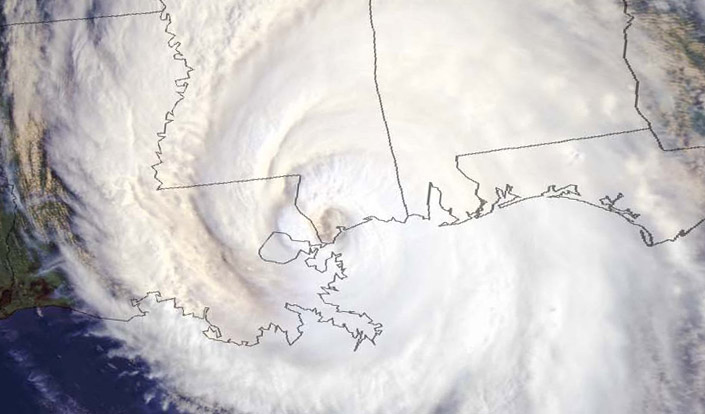
Katrina's eye, right over Mississippi
For years Hurricane Katrina was part of my science lessons.

How hurricanes form, how difficult it is to track them, what the heat of the Gulf of Mexico does to them, how Katrina wasn't even a hurricane by the time she hit New Orleans, what a storm surge is and how Katrina's filled up New Orleans like a bowl;  all of these things I covered.

What I never covered, and what the news media never covered, was what happened to the rest of the Gulf Coast, which was hit directly by a massive hurricane and a 30 foot storm surge (taller than Hall High School).
What used to be a residential community in Waveland, Mississippi.  No more.  Trees, houses, all wiped away.

Last month I visited a college friend that I had not seen in 40 years.  Tom lives in Biloxi.  He was the perfect host, driving me all over Biloxi, Christian Pass, and Waveland, showing me the sights.  Mostly what he showed me was huge expanses of empty coast - empty coast that had been covered with homes before August of 2005.

My friend's house had been severely damaged in the storm.  He told me about how he and his wife lived in a FEMA camp trailer for a year.  They pointed out building after building that was newly built after the storm.  They showed me pilings where homes had been blown away.

And then they sent me this link to photos of the area after the storm:

http://www.photosfromkatrina.com

While the media showed video clip after video clip of New Orleans, the people of Mississippi were quietly rebuilding from total disaster.


Signs of Spring

Until last Sunday, 95% of my yard was covered by snow.  Then it rained for 3 days.  Now there are only a few drifts of snow left.


Honeybees are awake and searching for food.
Remember that pesticides kill honeybees, and
without honeybees we will have no fruit.
Yesterday afternoon I sat out on my porch for the first time in 2014.  I love that porch - it extends my home out into the neighborhood.  It lets me sit comfortably while I greet the neighbors, listen to the bird song, enjoy my gardens.

Where the snow is gone, there are crocuses blooming - small, half-wild crocuses that were just waiting for the snow to melt before they opened up.  Each crocus was attended by several honeybees.  The bees had also been waiting for the warmth to emerge from their hives.

Saturday, March 29, 2014

Slide

The New York Times website has an interactive graphic to let you see the Oso, Washington area before and after the recent tragic mudslide.

http://www.nytimes.com/interactive/2014/03/26/us/houses-in-the-path-of-the-washington-mudslide.html

Click on the label to show the area before and after.

Frog Crossing

Last night we had the first real rainstorm of the Spring season.  

That means that under the drifts of leaves and the remaining drifts of snow the frogs and salamanders were waking up from their winter's sleep and heading to the nearest water.  Driving the back roads on rainy nights in early Spring is the best way to see them.
A wood frogsicle

Wood frogs in particular respond to that first rain.  Wood frogs spend the winter frozen solid.  Really.

When the warmish rains of early spring soak into the leaves where the frogs are buried, they thaw out, start breathing again, and make their way to ponds to breed.

A wood frog with his black mask
Wood frogs are easy to recognize by their masks.  Their call is also distinctive.  No 'jug-o-rum' for these guys.  A pond with a few wood frogs sounds like a flock of ducks all quacking at once.  A pond with a lot of wood frogs sounds like heavy machinery clanking through the woods.

On this morning's walk I went by the old mill raceway.  The streams were full of snowmelt and were thundering down the gorge.  The air was full of bird song as pairs of crows and robins and chickadees flew by.  It seemed like every male bird in town was screaming the bird equivalent of 'hey, bay-bee!'
Wood frog eggs from my frog pond
last year.  Soon they will be there again.

The raceway was full of water.  There were lots of ripples as the wood frogs moved about.  Soon there will be masses of eggs.

Most of the eggs will never become frogs.  Ducks will fly in and eat some of them.  Then the raceway, which is no longer connected to the brook, will dry up.  Only a few will survive to return to the raceway next year.

Friday, March 28, 2014

Spring At Last

Robins are no longer the first sign of spring.  They used to show up in early March.  Now they hang around all winter.

However, robin song is a true sing of spring, and I heard it for the first time today!  The lengthening days have worked their wonder on the brain chemistry of the male robins (they have darker heads).

And while about 80% of my yard is till covered with snow, in a few places it has melted and is covered with crocuses.

Sunday, March 23, 2014

What Will Happen On Wednesday?

For West Hartford to get the most snow, a storm must pass over the 40/70 benchmark.  That is, it must pass right over a spot that is at 40 degrees north latitude and 70 degrees west longitude.

That would send cold, wet winds over us from the northeast.

As of right now the upcoming storm will go too far to the south and east to really affect us. Rhode Island and Cape Cod will be buried.

I am predicting a regular school day on Wednesday, with increasing chances of a late opening the further east you go.

I will update this Monday night.